I returned home for a visit earlier this month and, without fail, upon telling people that I have recently moved to Mexico City, they asked:
1) How bad is the air?
2) How many people live there?
It doesn't bug me at all that these are inevitably the first questions out of everyone's mouth, because up until recently, I couldn't have come up with a heck of a lot more.
But I felt bad that I didn't have excellent, rock solid answers for these two questions. True, a bit part of the reason for this is that I simply didn't want to know. But that day of reckoning has come. We must face the truth.
Starting with the population because it doesn't directly affect my future lifespan.
The most recent estimates of Mexico City's population put it at 17.4 million for the Distrito Federal proper (which is kind of like Washington, D.C.). However, if you were just driving out of the Federal District, you wouldn't know you'd left it when you hit the border because many former towns of the surrounding State of Mexico have been gobbled up. The estimate for the metropolitan area is more like a mere 22.65 million, as of 2005, making it the second most populous metropolitan area in the world. Go Mexico! I'd say, "Tokyo, you are so going down," but they are seriously kicking ass.
1. Tokyo, Japan - 34,100,000
2. Mexico City, Mexico - 22,650,000
3. Seoul, South Korea - 22,250,000
4. New York, United States - 21,850,000
5. Sao Paulo, Brazil - 20,200,000
6. Mumbai, India - 19,700,000
7. Dehli, India - 19,500,000
8. Los Angeles, United States - 17,950,000
(source about.com)
By more strenuous standards taking note of actual boundaries, Mexico City gets knocked down to 5th place, but seriously, I really doubt anyone's counting past 15 million.
1. Tokyo-Yokohama, Japan - 33,200,000
2. New York, United States - 17,800,000
3. Sao Paulo, Brazil - 17,700,000
4. Seoul-Incheon, South Korea - 17,500,000
5. Mexico City, Mexico - 17,400,000
6. Osaka-Kobe-Kyoto, Japan - 16,425,000
7. Manila, Philippines - 14,750,000
(source about.com)
Since lists are so much fun, we'll start there. However measuring pollution isn't really all that easy so take this worth a gram of particulate matter...
http://news.bbc.co.uk/1/hi/sci/tech/5072642.stm#pollution
The BBC posted info from 2002 measuring pollution by amount of particle matter, by which the top contenders were:
1. Delhi
2. Cairo
3. Calcutta
4. Tianjin, China
Mexico City was all the way behind at 41st.
The Blacksmith Institute did another study in 2006, looking at the health danger of these pollutants and came up with this list:
The 10 worst-polluted places in the world are (in alphabetical order):
Chernobyl (Ukraine) | Dzerzinsk (Russia) | Haina (Dominican Republic) | Kabwe (Zambia) | La Oroya (Peru) | Linfen (China) | Mailuu-Suu (Kyrgyzstan) | Norilsk (Russia) | Ranipet (India) | Rudnaya Pristan (Russia)
Most have serious heavy metal or nuclear pollution which is making a lot of people sick.
So what's the deal with Mexico City?
Pollution isn't just about what factories and cars are spitting out. There are some unnegotiable geographic factors at play here:
- Mexico City is an average of 2,240 m (7,349 ft) above sea level
- It is located in a valley surrounded by mountains on all four sides with only one tiny opening at the north.
- "The region receives anti-cyclonic systems, whose weak winds that do not allow for the dispersion outside the basin of the air pollutants which are produced by the 50,000 industries and 4 million vehicles operated in the metropolitan area"
(source: wikipedia.com)
I haven't found the ultimate source that explains just where everything stands right now. To pull an Oprah - "What I know for sure" -
- It looks smoggy a lot and sometimes my lungs hurt.
- Traffic is something else and 1.5 hours is about the average commute within the city regardless of distance.
- The situation is bad enough that the government has imposed policies like certain cars can only drive certain days of the week and a month ago, the air hit such a point that they were stopping cars at the entrance to the city and not letting anyone in without Distrito Federal plates.
This was the article I found most interesting about combatting pollution, so I'll just end it there for the moment. And don't let the air deter you guys from visiting me.
http://www.ipsnews.net/news.asp?idnews=39090
"If these measures are not fully implemented, the chaos in the city could reach crisis level and we will all be sorry," Oscar Terrazas, professor of urban planning at the Autonomous Metropolitan University (UAM), told IPS. "What lies ahead is true chaos."
Enlightened prophet or alarmist? We'll see in 10 years.
Sunday, August 26, 2007

Let's learn about brands!

Isn't mini-Walmart the cutest learning experience ever?! I was kind of partial to the Pfizer lab though.
This past weekend, I took a trip with my nephews to Papalote (Kite), the children's museum in Chapultepec Park. In many ways, it was everything I would expect from a children's museum - there was an Imax theater, there were games, there were helpers in orange vests reading "Cuate" (Friend), and it was about 95% educational pandemonium. There was one way it differed from the other children's museums I've visited however - all the major exhibits were branded. The science lab was Pfizer Laboratory. The mini grocery store was Walmart. The make-your-own newspaper was Reforma. And I came out with vaguely positive feelings toward Nestle, though I don't remember what their name was tied to.
The advertising industry sometimes gets a bad rap as a bunch of unabashed money-grubbers who use psychology to manipulate people and make them buy things they don't need. Usually I prefer to put the onus on the general public to be a little more critical - you don't have to buy what they sell after all. However, there was something vaguely malevolent about the rampant branding of the non-profit children's museum.
It didn't surprise me though. However many "branded messages" I get a day in the U.S., it's got to be double here. Every possible space is sold for advertising - I pass 20 street-level billboards on the way to work alone - and illegal billboards clutter every sky line.
As we walked out of the museum, we passed a bright red Coca Cola soda fountain with interactive screens, set up as an educational station, and my 5-year-old nephew took a veer right into it. "I'm thirsty," he pronounced.
Sunday, July 29, 2007
Sex sells (autoparts)


What the guys see and what the girls see
A couple of weeks ago, I had the distinct pleasure of spending three full days at Expo Automotriz at Centro Banamex here in Mexico City. The massive expo was full of stands for things like spark plugs, door handles, car jacks and what-not. The aisles were full of Mexican mechanics and the stands were full of hot girls in lycra outfits (which, thank God, I was not rocking).
I was representing my new employer, who develops industrial parks throughout Mexico. Hopefully, we'll snag some new clients out of the Expo - most of my day was spent handing out pens and little red balls with our logo on it and telling confused-looking people just what we do. Most of the guys were more interested in hitting up the stands whose hostesses were wearing less clothing. The girls above were the unofficial favorite, causing a mild traffic jam for the entire three days. There were lines 30 deep in some places to get a signed poster.
There were three of us blondes in our stand and even we fielded a handful of requests for photos. Just what these photos are used for, I don't even want to know. I was walking behind a middle-aged couple and the woman remarked to her husband as they passed, "Ella está buena. ¿Quieres tomar una foto con ella?/She's hot. Want to take a photo with her?" Right...
My new vocabulary word of the week was: edecán, which is a catchall term for sexy girls who promote stuff. We had two of our own edecanes in the stand, one of whom runs her own edecan service and filled me in on this fascinating line of work.
1) The girls come in three flavors: A, AA and AAA. AAA are really hot, basically supermodels and they get paid as much as $35 to $40 an hour. AA are cute, swelling the ranks, and don't get paid quite as much. A would be classified as normal people and they might only get $70 for the whole days work and more gigs like serving samples at Costco.
2) The gigs include everything from working conference booths during the day to handing out free shots of whisky at a night club from 10 p.m. to 2 a.m. Sometimes they get to travel to nice resorts and work there all week.
3) Work attire ranges from suits to little spandex outfits. One of the girls said she worked an Axe promotion in a nightclub. At one point a guy started spraying axe all over himself and that was the cue for the girls working throughout the club to start stripping.
4) Clients request what kind of girl they want and look at photos. They might request Mexican girls or güeras or Brazilian girls or who knows what. One time, she had a client request 40 blue-eyed blondes.
Sunday, July 1, 2007
¿Por qué estas aqui?
Todo el mundo me hace esta pregunta. Y de verdad no tengo una buena respuesta, más que decir “Pues, no sé. Me gusta México.”
A veces pienso en Portland, San Francisco y Sonoma, lugares bonito, las montañas, mi gente. Pero no tengo ganas de estar allá.
Más o menos lo que me pasó es que estaba aburrida. Traté de animar mi vida. Leí mucho, viajé a varias partes del norte de California, pero ya no estaba contenta. Me faltaba algo – quizás más que nada lo inesperado. Vine aquí sin expectativos, sin esperar algo, por eso todo que encuentro es inesperado. Mi hermana me preguntó si la vida aqui es diferente que lo me imaginaba. Casi todo es diferente. Pensé que iba a pasar quizás un mes con mi hermana y después mudarme a Guadalajara o Guanajuato, algún ciudad mas pequeña, para trabajar como una reportera de freelance y profesora de inglés. Tres meses después de llegar aquí, todavía vivo con mi hermana, cuñado y sobrinos por elección y acabé de empezar a trabajar para mi cuñado en el campo de parques industriales. ¿Existe una situación más inesperada?
Por eso me mudé aquí. Porque de verdad no tuvo sentido ninguno y por eso tiene sentido. Y porque la comida mexicana es muy rica.
A veces pienso en Portland, San Francisco y Sonoma, lugares bonito, las montañas, mi gente. Pero no tengo ganas de estar allá.
Más o menos lo que me pasó es que estaba aburrida. Traté de animar mi vida. Leí mucho, viajé a varias partes del norte de California, pero ya no estaba contenta. Me faltaba algo – quizás más que nada lo inesperado. Vine aquí sin expectativos, sin esperar algo, por eso todo que encuentro es inesperado. Mi hermana me preguntó si la vida aqui es diferente que lo me imaginaba. Casi todo es diferente. Pensé que iba a pasar quizás un mes con mi hermana y después mudarme a Guadalajara o Guanajuato, algún ciudad mas pequeña, para trabajar como una reportera de freelance y profesora de inglés. Tres meses después de llegar aquí, todavía vivo con mi hermana, cuñado y sobrinos por elección y acabé de empezar a trabajar para mi cuñado en el campo de parques industriales. ¿Existe una situación más inesperada?
Por eso me mudé aquí. Porque de verdad no tuvo sentido ninguno y por eso tiene sentido. Y porque la comida mexicana es muy rica.
Funny signs

Not a sign, but funny. The bookstores in Mexico aren't big on attractive or themed displays. Here's a typical shelf - "Lesbianism in Mexico," "Red Abortion!" and "Learn Japanese in 30 Days."

This place is sacred. Respect it, vendors and lovers. (Courtyard of church in Cuernavaca)
 No pets without diapers. (Pasaje Polanco, DF, in front of Café Snob)
Sunday, June 24, 2007
¡Lucha libre!


Get your game face on.


This is me with one of the luchadoras. Yeah, that's her in the photo behind us, holding her infant son.
Pro wrestling of any sort is not a natural interest of mine. When I was a freshman in high school, a guy started a WWF Club for his senior project, putting on several outrageously ridiculous spectacles of posing, jumping around and doing other staged tricks. Loved it. Then Jack Black did Nacho Libre and I was pretty much sold. So I’ve been meaning to get to the luchas since I got here, and started easing my way in last weekend by going to a lucha libre photo exhibition plus espectacular at the Auditorio Nacional.
Basically what we’re talking about here are a bunch of 250-pound men in lycra climbing the ropes and jumping on top of each other before a completely wigged-out audience. It’s great. Some say they don’t “get” lucha libre. There’s nothing to get. We’re not talking about edutainment here.
So I happily joined the throngs, many of them rocking their own shiny lucha libre masks, and cheered as two burly women from Mexico tore into a couple of Japanese girls in ruffled hot pants. ¡Eso es, Mexico!
Thursday, June 14, 2007
Do the right thing
I'm from California, so I'm used to heavy-handed public service announcements discouraging smoking, beating your wife or drinking and driving. We're all about that. When my friend visited from Wyoming and saw some of our run-of-the-mill anti-smoking ads, I think it cemented her initial assessment that Californians are wackos.
Here in Mexico, the social crusaders take another approach. They put the warning right in with the commercial, which leads to some pretty funny juxtapositions. For instance, any beer ad will have a short message in capital letters across the bottom reading something along the lines of "TODO CON MEDIDA/DRINK RESPONSIBLY." What cracks me up is that the warnings go far beyond "The surgeon general really thinks you shouldn't smoke like a chimney."
For instance, shampoo commercials usually have a message reading: "SALUD ES BELLEZA/HEALTH IS BEAUTY."
Coca Cola ads (and I think I see about 10 a day) often have the messages: "HAZ DEPORTES" or "HAZ EJERCICIO." A Fresca ad: "COME FRUTA FRESCA." Yeah, those people may look like they're having fun tossing back calorie-laden sodas, but don't forget - eat healthy food! And one of my favorites? Delaware Punch - "COME UVAS Y VERDURAS/EAT GRAPES AND VEGETABLES."
Wow, thanks for that inspiring message. You know what? I'll do that.
Here in Mexico, the social crusaders take another approach. They put the warning right in with the commercial, which leads to some pretty funny juxtapositions. For instance, any beer ad will have a short message in capital letters across the bottom reading something along the lines of "TODO CON MEDIDA/DRINK RESPONSIBLY." What cracks me up is that the warnings go far beyond "The surgeon general really thinks you shouldn't smoke like a chimney."
For instance, shampoo commercials usually have a message reading: "SALUD ES BELLEZA/HEALTH IS BEAUTY."
Coca Cola ads (and I think I see about 10 a day) often have the messages: "HAZ DEPORTES" or "HAZ EJERCICIO." A Fresca ad: "COME FRUTA FRESCA." Yeah, those people may look like they're having fun tossing back calorie-laden sodas, but don't forget - eat healthy food! And one of my favorites? Delaware Punch - "COME UVAS Y VERDURAS/EAT GRAPES AND VEGETABLES."
Wow, thanks for that inspiring message. You know what? I'll do that.
Thursday, June 7, 2007
Ch, ch, ch
There are always photo exhibitions along the fence of Chapultepec park and right now, there are photos from ABCDF, a photo dictionary of Mexico City with over 2,000 images. Lots of cool pics and some great essays, including one about street names that I might have to share with you guys. In the "Ch" section, they printed the lyrics to the song, "Chilanga Banda" by Cafe Tacuba. A little taste:
¡Ya chole, chango chilango!
¡Qué chafa chamba te chutas!
No checa andar de tacuche
y ¡chale! con la charola.
I decided my Spanish lesson of the day could be to look up all the words I didn´t know. Of the 50 words that were drawing a blank, about half were in the dictionary (all with the caveat: Mexican slang), another half my co-workers could define and that remaining 25% - ¿Quién sabe? Of those 50 words, I think I could probably only use about 5 in mixed company and I'd still get some weird looks. All good fun. Check out the music video -
Chilanga Banda
¡Ya chole, chango chilango!
¡Qué chafa chamba te chutas!
No checa andar de tacuche
y ¡chale! con la charola.
I decided my Spanish lesson of the day could be to look up all the words I didn´t know. Of the 50 words that were drawing a blank, about half were in the dictionary (all with the caveat: Mexican slang), another half my co-workers could define and that remaining 25% - ¿Quién sabe? Of those 50 words, I think I could probably only use about 5 in mixed company and I'd still get some weird looks. All good fun. Check out the music video -
Chilanga Banda
The metro
The first time I came to Mexico City, I was surprised to learn there was a subway system. Actually, the subway system is easily the fastest way to get around this endless city and my friend who commutes to New York City every day gave it higher marks than the Big Apple´s famous subway. A big plus is it only costs 2 pesos (22 cents) to ride. I take the “limosina naranja,” as my friend calls it, to and from work two days a week. In the neighborhoods at the heart of the city, the subway is firmly underground – a full two long flights of stairs at the nearby station Polanco. At the edges of the city, however, it pops out of the ground, soaring above the graffitied walls and apartment high rises that stretch as far as the eye can see. Even from a viewpoint, Mexico City seems to have no end.
I leave my house at 7:30 a.m., joining the throngs of bustling professionals, street vendors hawking yogurt, gelatin and steaming coffee, and the occasional guitar player. I walk the tree-lined streets of Polanco and descend the gray marble steps into the dim station. When I ride the metro, I truly feel that I live in a city of 20 million. So many feet have padded down these steps that they carry smooth rounded hollows, as though a constant waterfall has dripped its way down over hundreds of years. I step into the flow of people pouring into the station and we line the tracks to wait in the stifling heat of the tunnel. Within minutes, an orange car whooshes up, packed with people. Some push out, some push in, and we’re off again.
A young guy, sometimes really just a boy, unzips his backpack to reveal a speaker and immediately starts blasting us with either ranchera music, the equivalent of America’s twangy country-western, lovesick trovas and boleros, or Spanish versions of American hits ranging from the Beatles to Celine Dion. The burned CDs always cost 10 pesos. Like all the vendors, his pitch is a torrent of familiar words, delivered in a bizarre, high-pitched voice which I’ve learned preserves the vocal chords over a long workday. By the next station, he’s hopped off and another’s hopped on, abruptly changing the soundtrack of our ride.
We pour off the train at Tacubaya, and wind our way to the brown line. The only people talking have cell phones pressed to their ears. Otherwise, there is no noise but the rustling of nylon and polyester and the shuffling of feet. Strains of music wind their way from some other nook or cranny of the station. Parts of the passageways are lined with small booths hawking primarily pizza, donuts and other unhealthy food and “productos naturistas,” just in case you want to pick up a homeopathic remedy for your male-pattern baldness on your morning commute.
One day, the brown line was down so my friend and I had to hop on the lengthier pink line. When we reached Tacubaya, we popped out into a cavern of intricate murals that seemed like a subterranean church. I had never been to this part of the station – I don’t know if I could find my way back again.
I know I’m close to my destination when orange sunlight oozes through the gloom, a sunbeam catching a face here, a purse there as we emerge from the bowels of the metro.
I leave my house at 7:30 a.m., joining the throngs of bustling professionals, street vendors hawking yogurt, gelatin and steaming coffee, and the occasional guitar player. I walk the tree-lined streets of Polanco and descend the gray marble steps into the dim station. When I ride the metro, I truly feel that I live in a city of 20 million. So many feet have padded down these steps that they carry smooth rounded hollows, as though a constant waterfall has dripped its way down over hundreds of years. I step into the flow of people pouring into the station and we line the tracks to wait in the stifling heat of the tunnel. Within minutes, an orange car whooshes up, packed with people. Some push out, some push in, and we’re off again.
A young guy, sometimes really just a boy, unzips his backpack to reveal a speaker and immediately starts blasting us with either ranchera music, the equivalent of America’s twangy country-western, lovesick trovas and boleros, or Spanish versions of American hits ranging from the Beatles to Celine Dion. The burned CDs always cost 10 pesos. Like all the vendors, his pitch is a torrent of familiar words, delivered in a bizarre, high-pitched voice which I’ve learned preserves the vocal chords over a long workday. By the next station, he’s hopped off and another’s hopped on, abruptly changing the soundtrack of our ride.
We pour off the train at Tacubaya, and wind our way to the brown line. The only people talking have cell phones pressed to their ears. Otherwise, there is no noise but the rustling of nylon and polyester and the shuffling of feet. Strains of music wind their way from some other nook or cranny of the station. Parts of the passageways are lined with small booths hawking primarily pizza, donuts and other unhealthy food and “productos naturistas,” just in case you want to pick up a homeopathic remedy for your male-pattern baldness on your morning commute.
One day, the brown line was down so my friend and I had to hop on the lengthier pink line. When we reached Tacubaya, we popped out into a cavern of intricate murals that seemed like a subterranean church. I had never been to this part of the station – I don’t know if I could find my way back again.
I know I’m close to my destination when orange sunlight oozes through the gloom, a sunbeam catching a face here, a purse there as we emerge from the bowels of the metro.
Let’s talk about condiments
I threw a dinner party for some Mexican friends the other night. My Thai chicken curry got rave reviews, but when I left the room, I heard a smattering of discussion about the food. Naturally, I returned to the table to interrogate everyone. My friends assured me the food was indeed delectable, but it was just weird to them that there weren’t any condiments, since most Mexican meals require at least three additives.
I considered this conversation a bit of a revelation, in the sense of realizing something which was blatantly obvious all along, namely that Mexicans are really into condiments. The bare minimum for most meals is chopped onion and cilantro, lime wedges, maybe some jalapeños, and, naturally, at least a choice of red or green salsa. If you’re having tortilla soup or pozole, you’ve also got to include crumbled cheese, pork rinds, and avocado. Seriously, tables in Mexico should be at least twice as big to hold all those little bowls.
My rather no-duh observation was confirmed the next day when I popped into a seafood place for ceviche. There was barely room on the table for the food, due to the wide variety of condiments available and I was eating alone. I consider this photo the confirmation of my theory. Case closed.

I considered this conversation a bit of a revelation, in the sense of realizing something which was blatantly obvious all along, namely that Mexicans are really into condiments. The bare minimum for most meals is chopped onion and cilantro, lime wedges, maybe some jalapeños, and, naturally, at least a choice of red or green salsa. If you’re having tortilla soup or pozole, you’ve also got to include crumbled cheese, pork rinds, and avocado. Seriously, tables in Mexico should be at least twice as big to hold all those little bowls.
My rather no-duh observation was confirmed the next day when I popped into a seafood place for ceviche. There was barely room on the table for the food, due to the wide variety of condiments available and I was eating alone. I consider this photo the confirmation of my theory. Case closed.

Q: Why is Mexican beer so crappy?
A:. Just add chile.
I have always considered the exportation of Mexican beer an advertising success story. I have seen Corona beer selling in New Zealand grocery stores for over two bucks a bottle and Corona is a frat-house staple across the great U.S. of A., despite the fact that it tastes like piss if you can say it actually tastes like anything at all. And Corona is one of the better Mexican beers, indistinguishable in a blind tasting between Sol, Tecate, Dos X or Indios. The only positive attributes of a Mexican beer, as far as I can tell, is that it’s bubbly and it contains alcohol.
Having spent the last five years in Portland, Oregon, where even the lousiest corner market still has an impressive selection of microbrews, I didn’t used to waste my time with Mexican beers. If I’m going for an import, I’ll take a Belgian ale, thanks very much.
Since migrating to Mexico, Mexican beer is pretty much my only choice, and I’ve been hitting up the Negra Modelo, the only dark beer that seems to be widely available. However, I’ve changed my tune a bit since I’ve been enlightened to the correct use of Mexican beers. Beer is not usually considered something which requires instructions, but seriously, ask a Mexican for help before you think about downing a couple Sols.
Think of Mexican beer as cake mix. Just add…all the good stuff. In the case of beer, a wedge of lime at best. Or make yourself a michelada – right up there with shandy on refreshment scale (ignore your hipster friends if they are thumbing their nose at you over their pints of microbrewed, extra-dark porter, served room temperature). To make a michelada, squeeze the juice of an entire lemon into your glass, slide it around the edge, then pour a helluva lot of salt around the rim. Then, and only then, add beer. Delicious. Up the ante with a liberal dose of chile powder, whether around the rim or just dumped around the inner sides of the glass. If you really want to go big, keep the lime and salt, then also add about a half cup of tomato juice, a dash of hot sauce and Salsa Maggi (basically soy sauce).
That is how it is done, my friends. Aren’t you glad the beer didn’t have any flavor to prevent you from enjoying the tasty lime and chile?
I have always considered the exportation of Mexican beer an advertising success story. I have seen Corona beer selling in New Zealand grocery stores for over two bucks a bottle and Corona is a frat-house staple across the great U.S. of A., despite the fact that it tastes like piss if you can say it actually tastes like anything at all. And Corona is one of the better Mexican beers, indistinguishable in a blind tasting between Sol, Tecate, Dos X or Indios. The only positive attributes of a Mexican beer, as far as I can tell, is that it’s bubbly and it contains alcohol.
Having spent the last five years in Portland, Oregon, where even the lousiest corner market still has an impressive selection of microbrews, I didn’t used to waste my time with Mexican beers. If I’m going for an import, I’ll take a Belgian ale, thanks very much.
Since migrating to Mexico, Mexican beer is pretty much my only choice, and I’ve been hitting up the Negra Modelo, the only dark beer that seems to be widely available. However, I’ve changed my tune a bit since I’ve been enlightened to the correct use of Mexican beers. Beer is not usually considered something which requires instructions, but seriously, ask a Mexican for help before you think about downing a couple Sols.
Think of Mexican beer as cake mix. Just add…all the good stuff. In the case of beer, a wedge of lime at best. Or make yourself a michelada – right up there with shandy on refreshment scale (ignore your hipster friends if they are thumbing their nose at you over their pints of microbrewed, extra-dark porter, served room temperature). To make a michelada, squeeze the juice of an entire lemon into your glass, slide it around the edge, then pour a helluva lot of salt around the rim. Then, and only then, add beer. Delicious. Up the ante with a liberal dose of chile powder, whether around the rim or just dumped around the inner sides of the glass. If you really want to go big, keep the lime and salt, then also add about a half cup of tomato juice, a dash of hot sauce and Salsa Maggi (basically soy sauce).
That is how it is done, my friends. Aren’t you glad the beer didn’t have any flavor to prevent you from enjoying the tasty lime and chile?
Cartas para enamorar/Letters of seduction

Por el Secretario de los amantes/By the secretary of lovers
Biblioteca de Amor/Love Library
México, D.F.
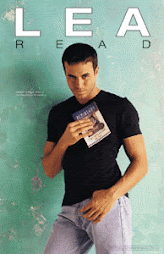
I made the best 10 peso purchase imaginable today. For only $1 US, I purchased a slightly faded, and/or stained paperback copy of Cartas para enamorar at a discount book shop in el Centro. This little treasure begins on page 5 with ¨LO QUE ES EL AMOR/WHAT IS LOVE¨ and by page 74, is offering “CARTA DE UN VIUDO PIDIENDO RELACIONES A UNA SOLTERA/HOW WIDOWERS CAN WRITE TO WIDOWS REQUESTING TO BEGIN A RELATIONSHIP.” In between, it touches on how to look for a girlfriend, how to dress when you’re courting and the symbolic meaning of how you use your handkerchief or fan. The meat of the book, however, is a series of proper letters and responses for every amorous situation imaginable (or unimaginable). I get the sense there may be cultural courtship differences here when the book begins with how to ask the girl’s parents if you can marry her.
As I read over the many letters in this slim volume, I can’t help but think, “Damn that’s good. Why didn’t I think of that?” Unfortunately, there is no copyright date on this book so I have no idea when I was written. Based on the contents, I would say, the Victorian era, perhaps turn of the century. Based on the cover design, I would lean toward the 1970s. These letters are too great not to share – I've put some excerpts worthy of swooning (potential suitors take note) in the column at right.
Monday, June 4, 2007
Ilegal
On May 31, I realized I have been living in Mexico City for over two months. This came as a momentous revelation because it meant my tourist visa had expired some days ago, making me "ilegal." Oops. My co-workers got quite a kick out of this, needless to say, and Ana immediately put on Manu Chao's "Clandestino," which I made her turn down while I called Mexican Immigration and asked some theoretical questions about overstaying visas on behalf of a "friend." The next day, I dragged my butt down to the immigration office, got in line behind about 50 people and hunkered down with my iPod. When the doors opened, I was the sole person in the tourist line and the official took a look at my paperwork, sent me to the "Pay Fines" line where another guy decided the price of my transgression was $700 pesos ($70) which I paid at a bank down the street. Some more stamping of paper and voilá! I can now legally bum around Mexico until September. I'll try to avoid the fine next time around - not to mention the irony.
Subscribe to:
Posts (Atom)